
A collaborative paper is published with Professor Andrew Mugler’s Group at the University of Pittsburgh regarding biophysical modeling of cellular sensing capability under chemical and fluidic cues in the Journal Physical Review Research.
Quantifying cellular autonomy in multicue environments
Louis González, Hogyeong Gwak, Bumsoo Han, and Andrew Mugler
Abstract
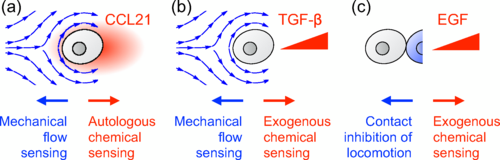
A cell routinely responds to one of many competing environmental cues. A fundamental question is whether the cell follows the cue prioritized by its internal signaling network or the cue that carries the most external information. We introduce a theoretical framework to answer this question. We derive information limits for four types of directional cues: external and self-generated chemical gradients, fluid flow, and contact inhibition of locomotion. When the cues compete as pairs, these limits predict which cue a cell should follow if its decision is based on environmental information alone. We compare these predicted decision boundaries with data from our and others’ cell migration experiments, finding cases where the boundary is obeyed and cases where it is violated by orders of magnitude. Both outcomes are informative, and we find that they rationalize known properties, or predict putative properties, of cells’ internal signaling networks. Our work introduces a physical framework to quantify the degree to which a cell acts like an autonomous agent, rather than a passive detector, favoring a cue even when it is less informative.